Fed Chair Kevin Warsh declined to signal rate moves at the IMF gathering Friday, explicitly stating the central bank is "no longer in the business of previewing its decisions." Despite hot inflation data and trader expectations of an October hold, Warsh's opacity suggests the Fed intends to maintain maximum flexibility and avoid forward guidance that could constrain future action.
Key points
Market impact. Bond markets initially sold off on the inflation surprise, but Warsh's refusal to commit to a pause has created uncertainty that could keep rates elevated longer than consensus expects. The 10-year yield and mortgage rates—already at 7.4%, the highest in nearly three years—may remain sticky if the Fed signals willingness to hike again despite economic softness.
Broader implications. Warsh's break from traditional Fed communication—rejecting the Greenspan-era playbook of forward guidance—represents a fundamental shift in central bank strategy. This opacity could amplify volatility in fixed income and equities as markets price in wider tail risks for monetary policy.
Sources (4)CNBC Economy, New York Post Business, New York Times Business +1
Strong bearish −564 sourceswholesale inflation · energy · producer prices
The producer price index surged 1.3% in September—the largest monthly jump in four years—driven by soaring energy costs that pushed annual wholesale inflation to 6.3%, the highest since 2022. The spike came in far hotter than economist expectations and signals that input cost pressures remain stubbornly embedded in the supply chain.
Key points
Market impact. The data undermines the Fed's narrative of disinflation and raises the odds of sustained price pressures flowing through to consumer prices by year-end. Retailers and consumer staples companies face margin compression; energy stocks benefit from elevated commodity prices, but broader equity markets price in lower probability of aggressive rate cuts in 2025.
Broader implications. This inflation surprise directly contradicts the soft-landing thesis and validates hawkish Fed members who argue premature rate cuts could reignite price growth. Holiday season pricing power will be tested as companies decide whether to absorb costs or pass them to consumers already grappling with 7%+ mortgage rates.
Sources (4)New York Post Business, The Daily Caller, ABC News +1
Strong bearish −725 sourcescharacter.ai · disney · bankruptcy
Character.AI, the interactive chatbot platform that amassed millions of users in five years, filed for bankruptcy and agreed to sell assets to Disney for $20 million—a pittance relative to its prior valuation. The collapse follows a cease-and-desist from Disney last year and mounting legal liabilities, revealing how user scale alone cannot sustain AI startups without clear monetization or defensible IP.
Key points
Market impact. Disney's $60 million settlement with 66 employees signals the entertainment giant is acquiring talent and licensing rights on the cheap. The bankruptcy validates skepticism around unprofitable AI consumer plays and may dampen venture appetite for chatbot startups lacking differentiation or revenue models. Google's earlier acquisition of Character.AI's parent now looks prescient as a talent grab rather than a strategic asset purchase.
Broader implications. This is the first major casualty in the consumer AI boom, signaling that user growth and media buzz cannot substitute for unit economics. Expect consolidation to accelerate as well-funded incumbents (Disney, Google, Meta) acquire distressed AI startups for talent and IP rather than operating businesses.
Neutral +122 sourcescoreweave · ai infrastructure · sell-off
CoreWeave, the AI infrastructure provider, is being hammered by a continued sell-off Friday, but multiple Wall Street analysts are calling the decline "overblown" and arguing the market is mispricing the company's exposure to the AI compute buildout. The stock's weakness appears driven by sector rotation and profit-taking rather than fundamental deterioration.
Key points
Market impact. CoreWeave's valuation compression creates a potential entry point for long-term AI infrastructure investors, particularly as data center demand from large language model training remains robust. The sell-off also reflects broader volatility in high-growth tech stocks as investors reassess risk-reward in a higher-for-longer rate environment.
Broader implications. CoreWeave's weakness is a tactical opportunity rather than a strategic warning about AI infrastructure demand. The company's survival and profitability depend on sustained capex from hyperscalers (OpenAI, Google, Meta), which remains intact despite macro uncertainty.
Bearish −163 sourcesnike · turnaround · india expansion
Nike's stock has surged more than 8% this week after a disastrous year, driven partly by the company's announcement of a new India campus and expansion into the subcontinent. The move signals management confidence in long-term growth despite near-term headwinds in North America and Europe, where the sportswear giant has struggled with inventory and demand.
Key points
Market impact. Nike's India bet positions the stock as a turnaround play for investors seeking exposure to emerging market growth and consumer spending. However, the S&P 500's record highs are masking that nearly 40% of the index is in bear market territory, making Nike one of the few mega-cap names with genuine upside optionality if execution improves.
Broader implications. Nike's geographic diversification into India reflects the secular shift in consumer spending toward Asia and away from saturated Western markets. Success in India could validate the company's turnaround narrative and reignite institutional investor interest in a stock that has underperformed for years.
Sources (3)YouTube - Yahoo Finance, Market Watch, CNBC Business
Bullish +213 sourcesstarshield · ukraine · white house
The White House ordered temporary limits on Ukraine's access to SpaceX's Starshield satellite system, which has been critical for battlefield communications and drone operations. The restriction came from inside the administration and signals a shift in U.S. policy toward constraining military support for Kyiv, likely driven by geopolitical negotiations.
Key points
Market impact. Eutelsat's stock surged 19% on the news, as investors see reduced competition from Starshield and increased demand for alternative satellite communications providers. SpaceX's valuation and government contract pipeline face headwinds if Starshield becomes a political liability. Defense contractors with satellite capabilities (Lockheed Martin, Northrop Grumman) may see renewed interest.
Broader implications. The Starshield restriction signals a fundamental recalibration of U.S.-Ukraine policy and suggests the administration is preparing for negotiated settlement rather than indefinite military support. This has profound implications for NATO cohesion and European defense spending.
Tesla unveiled its 2026 Roadster, a $200,000+ electric sports car equipped with SpaceX rocket thrusters and capable of vertical takeoff. The vehicle is not a near-term revenue driver but rather a statement of technological prowess and a tool in Musk's talent wars—signaling to engineers and investors that Tesla-SpaceX integration is accelerating.
Key points
Market impact. The Roadster announcement is primarily a marketing and recruitment tool rather than a material earnings catalyst. However, it reinforces Tesla's narrative as a technology conglomerate rather than a traditional automaker, which could support premium valuation multiples. Investors should view this as a signal of Musk's ambition to merge Tesla, SpaceX, and Starlink into a unified holding company.
Broader implications. The flying Roadster exemplifies Musk's strategy to use flashy product announcements to attract talent and maintain media attention while core businesses (Tesla EV sales, SpaceX launches) face execution challenges. This is empire-building theater with real strategic intent.
Sources (4)Market Watch, YouTube - Yahoo Finance, Business Insider +1
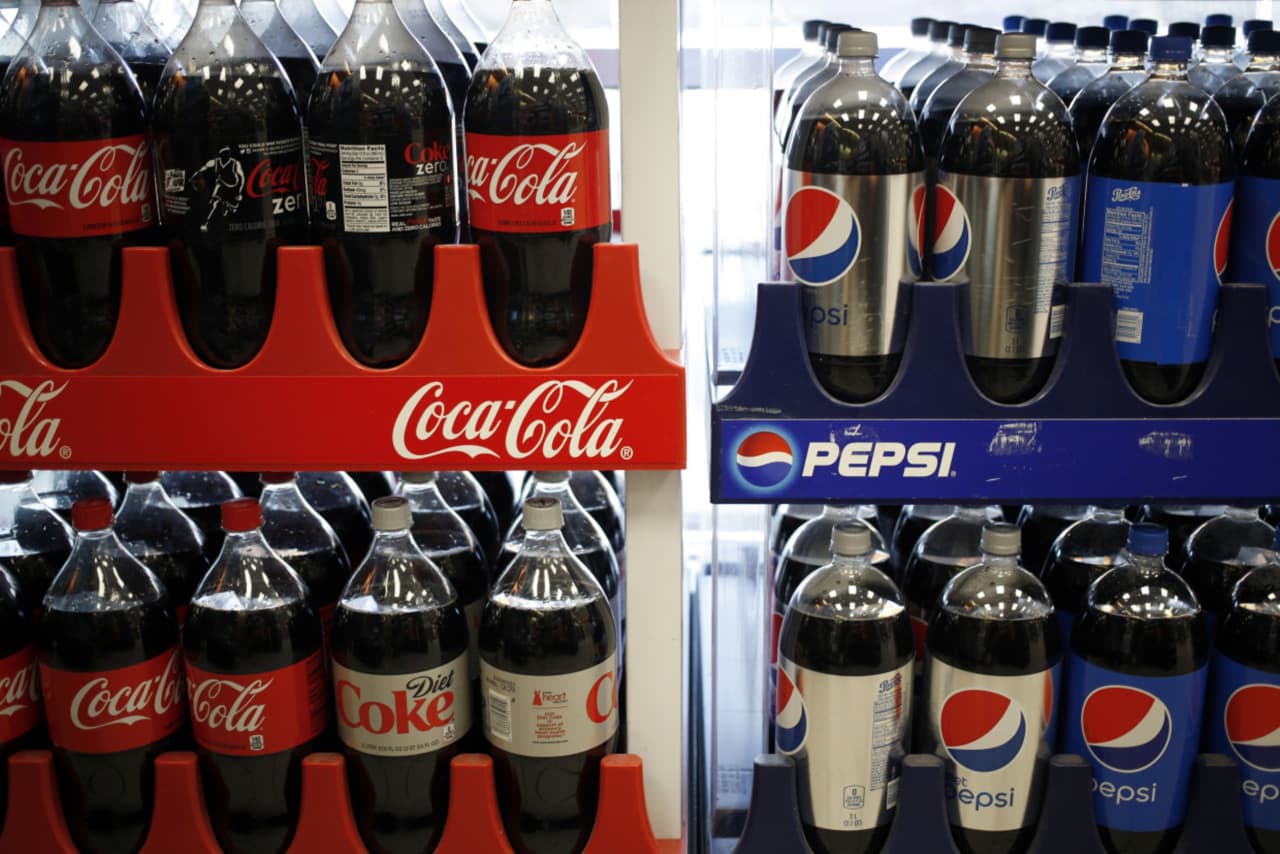
KFC is switching from PepsiCo to Coca-Cola as its beverage supplier for U.S. restaurants, ending a decades-long partnership. The move reflects PepsiCo's broader struggles in the soda category as consumers shift away from sugary drinks and toward energy drinks and water—categories where Coca-Cola has stronger positioning.
Key points
Market impact. PepsiCo (PEP) faces revenue headwinds from the KFC loss and broader beverage category weakness, pressuring margins and growth guidance. Coca-Cola (KO) gains distribution and reinforces its dominance in the soda wars. The shift is particularly damaging to PepsiCo because QSR partnerships are high-margin, high-volume channels that drive brand loyalty.
Broader implications. The KFC defection is symptomatic of PepsiCo's strategic vulnerability in beverages. The company's future growth depends on its snacks business (Frito-Lay, Quaker) and emerging categories, but losing QSR partnerships erodes its competitive moat and market share in a declining category.
Sources (3)Market Watch, New York Post Business, CNBC Business