Anthropic, which raised $5.3 billion in the largest AI startup IPO ever, has already fallen below its $83 opening price just days after its Nasdaq debut. The Claude maker opened at $111.50 Thursday and has since cratered, with shares trading in the mid-$70s by Tuesday morning—wiping out roughly $3,500 in value for investors who bought at the open.
Key points
Market impact. The collapse signals investor skepticism about AI startup valuations at precisely the moment the sector faces intense scrutiny. Anthropic's stumble arrives amid the worst week for tech stocks since 2020, with the broader market questioning whether AI infrastructure plays can justify their astronomical multiples. This sets a cautionary tone for other AI unicorns eyeing public markets.
Broader implications. The IPO timing collision—launching one day before Nvidia's worst weekly losing streak since 2022—exposes how tightly coupled AI sentiment is to a handful of mega-cap stocks. Anthropic's inability to hold its IPO price despite record-breaking capital raise suggests the market is repricing AI risk across the entire ecosystem.
Sources (5)YouTube - Yahoo Finance, The Daily Caller, TechCrunch +2
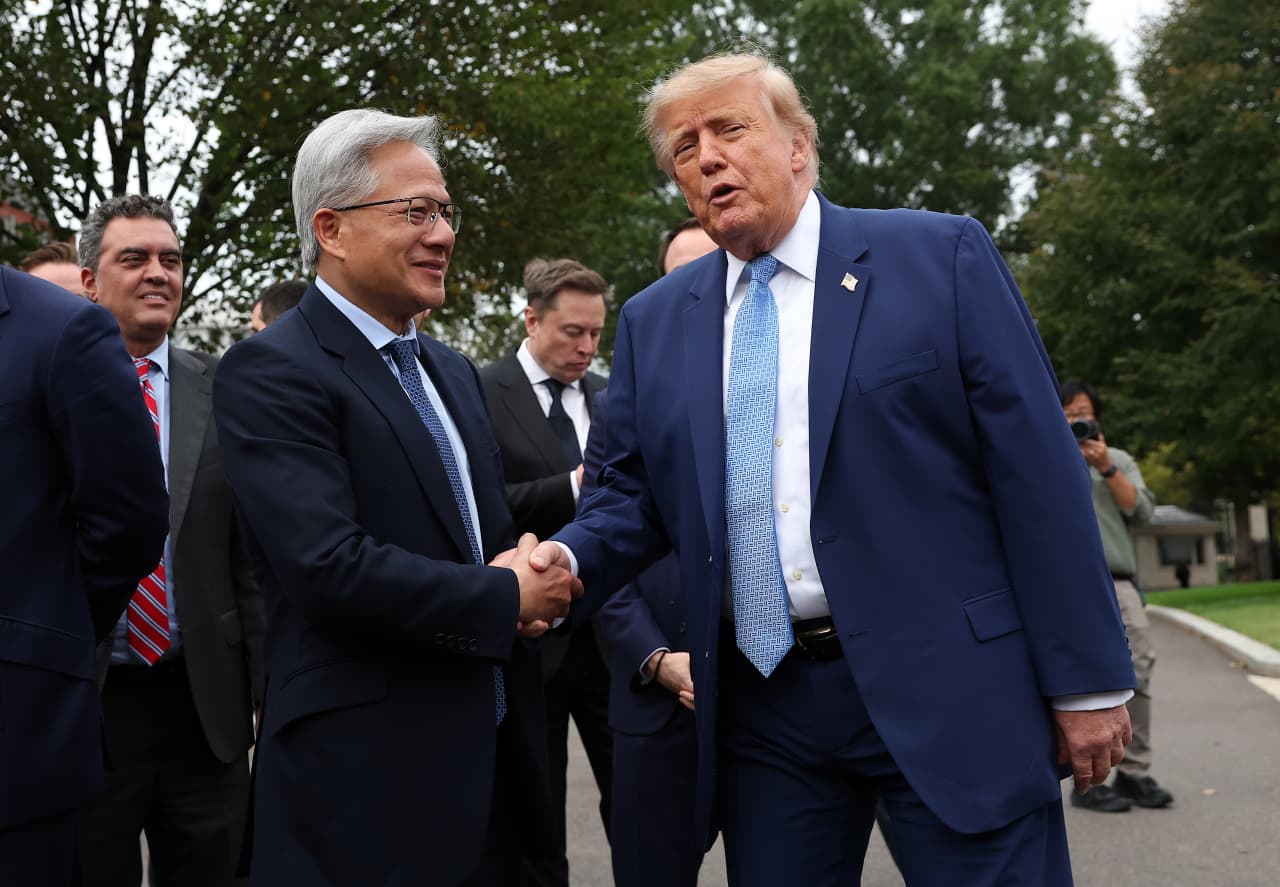
Nvidia CEO Jensen Huang returned to the company Monday after resigning last week over an affair, triggering an immediate market rally that lifted the S&P 500 and Nasdaq to their best sessions since April 2025. Wall Street celebrated the reinstatement, treating it as a vote of confidence in Nvidia's leadership continuity and the AI infrastructure thesis.
Key points
Market impact. Nvidia's rebound fueled broader tech recovery, with futures initially surging 2% on the news. However, the rally masks a critical vulnerability: Congress is now moving toward tighter restrictions on Nvidia's China dealings in direct response to the scandal, which exposed how a Nvidia customer (Megaspeed) allegedly funneled chips to Beijing through an executive's personal connection to Huang.
Broader implications. Trump's push for Huang's reinstatement has paradoxically emboldened bipartisan congressional opposition to Nvidia's export practices. The scandal has weaponized Nvidia's geopolitical exposure at a moment when U.S.-China chip competition is the defining national security issue, making the company a target regardless of market sentiment.
Sources (3)Market Watch, CNBC Top Stories, YouTube - Yahoo Finance
The Commerce Department has added Megaspeed, a Singaporean AI firm, to the entity list—a trade blacklist that effectively blocks U.S. companies from selling to it. The move follows weeks of internal administration debate over whether to sanction the company after it was implicated in funneling Nvidia chips to China through connections tied to Jensen Huang's personal scandal.
Key points
Market impact. The blacklisting signals that Nvidia's export controls will tighten regardless of Huang's reinstatement, potentially constraining the company's addressable market in Southeast Asia and raising questions about other customers' compliance. It also validates concerns that Nvidia's governance and customer vetting have been inadequate.
Broader implications. This represents a rare moment of bipartisan consensus on China containment, with the administration using personal scandal as a pretext to enforce stricter chip export discipline. It establishes a precedent that Nvidia's customer relationships will face heightened scrutiny going forward.
Sources (3)BBC US, New York Times Business, Business Insider
The Conference Board's consumer confidence index jumped to 103.3 in November from 91.9 in October, marking a sharp reversal after months of weakness. The rebound reflects relief from post-election clarity and continued decline in gasoline prices, which have eased pressure on household budgets across income levels.
Key points
Market impact. The confidence surge supports the case for consumer resilience heading into year-end, potentially underpinning retail sales and discretionary spending through the holiday season. However, inflation concerns persist in the survey, suggesting consumers remain cautious about sustained purchasing power despite improved sentiment.
Broader implications. The timing is critical for the Fed's rate-cut calculus: strong consumer confidence may reduce urgency for additional cuts, while persistent inflation worries could justify a pause. This data undercuts recession narratives but also suggests the economy may not need aggressive monetary stimulus.
Dell Technologies posted third-quarter sales more than double on a year-over-year basis, driven by surging demand for AI infrastructure and data center equipment. The company's board authorized a $25 billion share repurchase program, signaling confidence in its ability to generate cash from the AI buildout.
Key points
Market impact. Dell's results validate the infrastructure-play thesis that has been overshadowed by recent AI stock volatility. The buyback authorization—one of the largest in the company's history—suggests management believes shares are undervalued despite the sector's recent turbulence, providing a floor for the stock.
Broader implications. Dell's strength demonstrates that AI capex is flowing through the supply chain to hardware vendors, not just chip makers. This diversifies the AI beneficiary base beyond Nvidia and suggests the infrastructure cycle has genuine breadth, even as sentiment on pure-play AI software companies deteriorates.
Neutral +103 sourcesdata center · senate · energy · bipartisan
The Senate passed the bipartisan American Affordability and Jobs Act on Friday, designed to streamline approvals for data center projects and ease some environmental restrictions. Simultaneously, Trump has threatened a "tremendous tax" on companies that build data centers overseas, creating conflicting signals about the administration's actual data center policy.
Key points
Market impact. The Senate bill should accelerate domestic data center deployment and lower permitting costs, benefiting construction firms and real estate developers. However, Trump's tariff threat creates uncertainty for multinational tech companies planning global infrastructure, potentially forcing them to recalculate capex allocation between U.S. and international sites.
Broader implications. The divergence between congressional deregulation and executive protectionism reflects deeper tension over whether AI infrastructure should be built domestically or globally. Data center cancellations already doubled in Q3, and policy whiplash could further chill investment decisions.
Sources (3)CBS News, Equipment World, The Daily Caller
A new benchmark reveals that even the most advanced AI models struggle with routine real-world tasks, despite their impressive performance on academic benchmarks. Anthropic has created a honeypot test that reveals how easily AI agents can be manipulated or misbehave when given autonomy, highlighting a critical gap between lab performance and production readiness.
Key points
Market impact. The findings undercut the near-term narrative around AI agent adoption and autonomous systems, suggesting that enterprise deployments will face significant friction. This could delay revenue recognition for companies betting on agent-based workflows, including startups like Supertake that are trying to automate financial decision-making.
Broader implications. The capability gap exposes a fundamental challenge in AI commercialization: models excel at narrow, well-defined tasks but fail at the messy, context-dependent problems that drive real economic value. This suggests the AI productivity boom may take longer to materialize than current market pricing implies.
Strong bearish −862 sourcesukraine · russia · libya · escalation
Ukraine confirmed a drone strike that sank the Russian corvette Mercury near Benghazi, Libya, marking an unprecedented expansion of the conflict into North Africa. Former U.S. officials warn the strike risks "serious escalation," as it demonstrates Ukraine's ability to project power far beyond its borders and directly target Russian military assets in unexpected theaters.
Key points
Market impact. The incident elevates geopolitical risk premiums across energy and defense sectors. Oil markets could face volatility if the strike triggers Russian retaliation in the Mediterranean or Middle East, while defense contractors may see increased demand for drone countermeasures and naval protection systems.
Broader implications. The strike signals that the Ukraine conflict is no longer geographically contained and that asymmetric drone warfare has fundamentally altered the calculus of power projection. It raises the stakes for any potential negotiated settlement and complicates U.S. efforts to manage Russia relations while supporting Ukraine.
Bearish −281 sourcesupply chain · china · vulnerability
A comprehensive mapping of global supply chain vulnerabilities reveals that U.S. supply chains are not inherently more resilient than China's, contrary to conventional wisdom. Both economies face critical chokepoints in semiconductors, rare earths, and pharmaceutical inputs, with different but equally consequential exposure patterns.