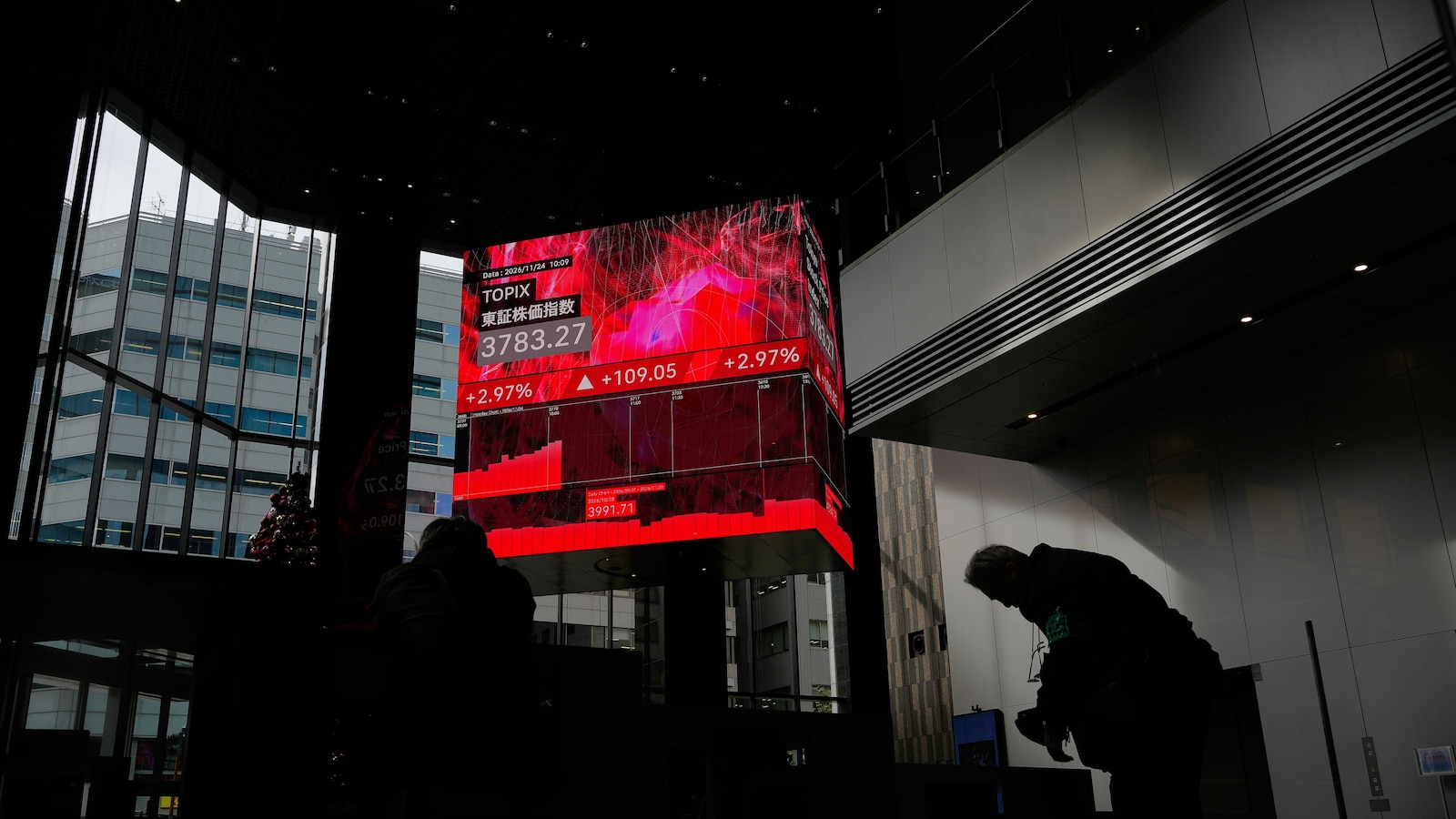
The Trump administration proposed fresh tariffs targeting 14 major trading partners including China, Japan, the EU, and India, framing the levies as a response to unfair trade practices and excess industrial capacity. The new round marks an escalation in trade protectionism and is expected to take effect in January.
Key points
Market impact. Tariff uncertainty is already weighing on equities; Asian stocks tumbled as AI shares retreated on Wall Street, and Bitcoin slid below $60,000 amid tariff nerves. Exporters and multinational corporations face margin compression, while import-competing sectors may see temporary support.
Broader implications. This signals a return to aggressive trade nationalism and threatens to reignite global supply-chain fragmentation. The EU and China will likely retaliate, creating a tit-for-tat cycle that could dampen global growth and complicate the Fed's inflation fight.
Sources (5)The Guardian Business, CNBC Top Stories, Washington Post Politics +2
S&P Global is considering downgrading Nvidia's credit rating to AA—, citing governance concerns and excessive reliance on CEO Jensen Huang. The move comes after Huang's abrupt departure and reinstatement, which exposed the company's vulnerability to leadership disruption amid its dominance in AI chip supply.
Key points
Market impact. A downgrade would increase Nvidia's borrowing costs and could trigger forced selling by credit-sensitive funds. Wall Street initially rallied on Huang's return, but the rating agency's scrutiny signals that the market's euphoria masks structural risks in the chipmaker's governance and succession planning.
Broader implications. This exposes a critical vulnerability in the AI boom: concentration of power and technical expertise in single individuals. If Nvidia's credit deteriorates, it could cascade through the AI supply chain and undermine confidence in the sector's financial stability.
Anthropic shares fell below its $83 IPO price less than a week after debuting at $111.50, having raised $81.3 billion in the largest IPO ever. The stock has shed roughly $3,500 in value per 100-share position, signaling investor skepticism about AI startup valuations and profitability timelines.
Key points
Market impact. The collapse pressures other AI startups' valuations and raises refinancing risks for private AI firms. It also undercuts the narrative that AI companies can command premium multiples indefinitely, forcing a repricing of the entire sector's growth assumptions.
Broader implications. This marks the first major test of whether AI hype can sustain valuations without near-term revenue or profitability. A sustained slump in Anthropic could trigger a broader AI correction and dampen venture capital appetite for the space.
Sources (5)YouTube - Yahoo Finance, The Daily Caller, TechCrunch +2
The Federal Reserve confirmed that inflation has not improved ahead of its December vote, with the PCE deflator rising again in October. Fed officials, including John Williams, signaled that higher rates are likely needed over time to bring inflation closer to the 2% target.
Key points
Market impact. Rate expectations have shifted higher, pressuring equities and fixed-income valuations. The December hike is now widely priced in, but forward guidance suggests the Fed will maintain a restrictive stance into 2027, capping multiple expansion and favoring defensive sectors.
Broader implications. Sticky inflation undermines the soft-landing narrative and suggests the Fed may need to keep rates elevated longer than markets hoped. This complicates the AI boom's financing story and raises recession risks if rate pressure persists.
Sources (3)Market Watch, New York Times Business, CNBC Finance
The U.S. economy expanded rapidly in summer and early fall, driven partly by AI-related capital spending and demand for chips. Dell's stock surged as AI server sales more than doubled, yet economists warn that an AI boom collapse would inflict painful economic damage.
Key points
Market impact. AI-linked stocks have become a critical driver of equity gains, but their volatility and valuation dependency on perpetual growth create systemic risk. A correction in AI spending could trigger broad-based selloffs and expose how much of recent GDP growth rests on speculative capex.
Broader implications. The economy is increasingly reliant on AI investment to offset weakness in consumer spending and housing. If the AI boom falters—due to oversupply, regulatory pressure, or valuation resets—the Fed may face a growth shock that complicates its inflation-fighting mandate.
Strong bearish −573 sourcesmicrosoft · outage · code red
Microsoft declared a "Code Red" emergency after a 24-hour outage on November 12-13 knocked out Outlook, Teams, Copilot, and other core services for most of its 420-450 million users. The company blamed an undetected Windows defect, marking the most disruptive outage in its history.
Key points
Market impact. The outage exposed operational risks in cloud infrastructure and raised questions about Microsoft's system resilience. Enterprise customers relying on Microsoft for mission-critical workflows faced significant downtime, potentially triggering SLA claims and customer churn.
Broader implications. This highlights the concentration risk in cloud computing, where a single vendor outage can paralyze global business operations. Regulators may scrutinize Microsoft's infrastructure redundancy, and competitors could exploit the incident to win market share.
Sources (3)The Verge, Fox News US, New York Post Business
The U.S. is investigating Megaspeed and Alice Huang—a Chinese businesswoman linked to Nvidia CEO Jensen Huang's affair—after discovering that companies tied to her listed $270 million in AI servers destined for China. China's Ministry of State Security may have surveilled Huang amid the scandal.
Key points
Market impact. The probe adds regulatory and geopolitical risk to Nvidia's valuation, compounding the governance concerns already flagged by S&P. Export controls and potential restrictions on Nvidia's China sales could materially impact revenue and earnings forecasts.
Broader implications. This underscores the intersection of corporate governance, national security, and AI chip supply chains. U.S. authorities may tighten oversight of Nvidia's leadership and China operations, while Beijing may retaliate against U.S. restrictions on chip exports.
Sources (3)CBS News, New York Post Business, CNBC Top Stories
Elon Musk announced that SpaceX will issue one newly minted Class A share to every active "Trump account" holder, with Musk personally matching the gift. The combined donation is valued at roughly $17.8 billion, cementing Musk's alignment with the Trump administration.
Key points
Market impact. The massive share issuance dilutes existing SpaceX shareholders and signals Musk's willingness to deploy capital for political influence. This could complicate SpaceX's future financing and valuation, while raising questions about governance at the private company.
Broader implications. The donation reflects the deepening entanglement between tech oligarchs and political power. Musk's leverage with Trump could translate into favorable regulatory treatment for SpaceX, Tesla, and his other ventures, while raising antitrust and conflict-of-interest concerns.
Sources (3)YouTube - Yahoo Finance, Market Watch, Business Insider
Pro-Ukraine hackers leaked Russian government data indicating that between 490,000 and 700,000 Russian soldiers have died since the February 2022 invasion. The figures exceed all combined U.S. military deaths since World War I, underscoring the war's devastating human toll.
Key points
Market impact. The casualty figures raise questions about Russia's ability to sustain the war effort and could pressure energy and commodity markets if Russia's military capacity deteriorates. Defense contractors and NATO-aligned equities may see support from heightened geopolitical tension.
Broader implications. The scale of losses signals that Russia's war strategy is unsustainable, potentially forcing Moscow toward negotiation or escalation. This uncertainty complicates energy markets and geopolitical risk premiums, while bolstering NATO's resolve to support Ukraine.